A Personalized Approach to Communication.
Deaf-Blind interpreting uses tactile sign language, close-vision signing, or tracking to communicate with individuals who have combined hearing and vision loss. Our interpreters work one-on-one to create a communication experience tailored to the individual’s level of vision and comfort. This service is often used in educational, medical, legal, and community settings. In addition to Interpreters, we can provide you with Co-Navigators (CNs) and Support Service Providers (SSPs) when extra support is needed.

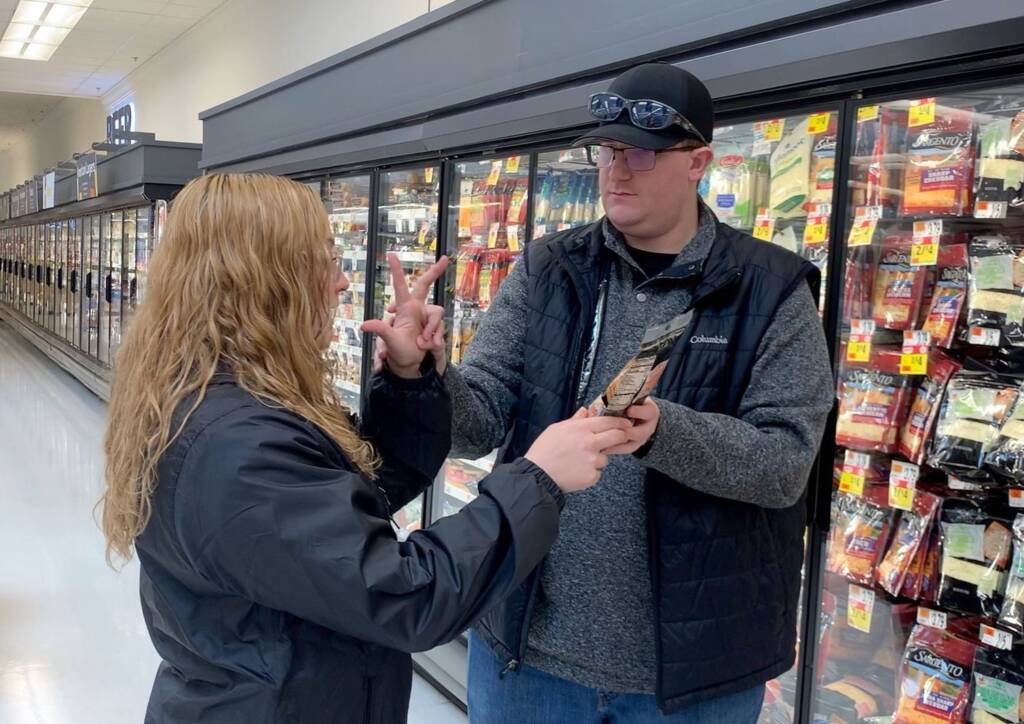
Environmental Access & Guided Support
For individuals who are Deaf-Blind, access extends beyond communication. Navigating spaces, gathering visual information, and participating fully in daily activities often requires specialized support. Our Co-Navigating / Support Service Providers (SSPs) offer environmental and mobility assistance that promotes independence and safety. Unlike interpreters, SSPs do not facilitate communication between parties. Instead, they provide sighted guiding, orientation in unfamiliar settings, access to printed and environmental information, and descriptive details about surroundings and nearby activity. SSP services empower individuals to move confidently through their environments while maintaining autonomy and choice.
Support patients during exams, hospital visits, or therapy sessions.
Ensure full participation in courtrooms, legal consultations, or public hearings.
Provide access in classrooms, campus events, or IEP meetings.
Help individuals engage in workshops, conferences, ceremonies, and more.
Our interpreters receive specialized training and ongoing education to best serve the DeafBlind community. We understand the importance of patience, trust, and flexibility, and we always prioritize the comfort, autonomy, and dignity of the individual.


Let us know the details of your appointment or event.
Based on location, communication needs, and interpreter expertise.
Trained, punctual, and prepared to provide personalized communication.
In addition to Interpreters, we can provide you with Co-Navigators (CNs) and Support Service Providers (SSPs) when extra support is needed.
Explore our nationwide coverage with our interactive service map below. Simply hover over your state to see available interpreting services and the cities we proudly serve. Allied Communication Interpreting Services connects clients with certified interpreters across all 50 states—ensuring clear, professional communication wherever you are in the U.S.
Posted on Google
 Dawn V
Trustindex verifies that the original source of the review is Google.
Top notch agency! Time and time again they send the best. A collection of talented and caring ASL providers for sure! Mandy is just a joy to work with!Posted on Google Laurie AchinI have worked with Allied Communication Interpreting Service for some time and have consistently had a positive experience. Their scheduling, punctuality, and interpreter qualifications have always met my expectations. I wholeheartedly endorse their services and would recommend them without hesitation.Posted on Google
 John SirakoulisOne of the best ! Had their service at concert and never disappointed! Top notch interpreters service ! You want the best ? Reached them out !!Posted on Google
 Matt WaringWe utilize Allied Communication Interpreting Services for our Sunday Morning Worship Service and they are incredible! We are deeply grateful for their agency's outstanding professionalism, exceptional service, and consistent flexibility. Their commitment to making an impact on the deaf community has greatly impacted our guests. I'm thankful for people like Amanda who are looking to make the world a better and inclusive place for all!Posted on Google
 Tish RollerACIS is a wonderful and proactive organization to work with. They reach out as each semester as the new one approaches to help determine the needs for the upcoming semester. Everything is handled in a timely and professional manner. Highly recommend working with ACIS for your interpreting needs.Posted on Google
 Sheila BanksAllied Communication Interpreting Services is wonderful to work with. They are super quick to respond to my request. Before using them, our program had a hard time finding reliable interpreters. I can honestly say that ACIS has taken that burden away. They are awesome and I would recommend them to anyone.
We’re here to help. Whether you’re planning ahead or responding to an immediate need, our team will provide the support and care you deserve.

deaf blind interpreting, deafblind, deafblind interpreting, deaf, interpreter, resources, information, national task force on deaf-blind interpreting, become a mentor, deaf blind interpreter, support service provider, ssp, service provider, service providers, service, providers, enable, support, services, provider
deaf blind interpreters
Tactile sign language and close-vision signing are specialized communication methods used by interpreters for individuals who are Deaf-Blind. Tactile sign language involves the interpreter placing their hands over the Deaf-Blind individual's hands to convey signs, allowing for a direct physical connection and understanding of the message. Close-vision signing is utilized when there is sufficient residual vision, where the interpreter signs within the individual's visual field, often at a closer range than standard sign language.
These methods require extensive training and sensitivity to the unique communication needs of each Deaf-Blind person. The interpreter must be adept at both techniques, adapting their approach based on the individual's preferences and abilities. This ensures that communication is not only accurate but also comfortable and respectful, fostering a strong sense of connection and trust.
Tracking is another crucial communication technique employed by Deaf-Blind interpreters, particularly when an individual has limited or no ability to feel tactile signs or see close-vision signing. In this method, the interpreter verbally describes the environment, the actions of people present, and any relevant visual information in real-time. This allows the Deaf-Blind individual to remain informed about their surroundings and participate more fully in conversations and activities.
The effectiveness of tracking relies heavily on the interpreter's descriptive skills and their ability to anticipate the information needs of the Deaf-Blind person. This might include describing facial expressions, body language, or the layout of a room. It's a dynamic process that requires constant attention and the ability to translate complex visual and social cues into understandable verbal descriptions, ensuring the individual's access to information and social engagement.
Support Service Providers (SSPs) play a vital role in enhancing the independence and participation of individuals who are Deaf-Blind, going beyond communication facilitation. While interpreters focus on conveying messages, SSPs provide essential environmental support and sighted guidance. This can include navigating unfamiliar spaces, gathering visual information from the surroundings, and offering descriptive details about people and activities occurring nearby.
SSPs are trained to assist with tasks that require visual perception and spatial awareness, such as reading signs, identifying objects, or understanding the context of a situation. Their presence ensures that Deaf-Blind individuals can engage more fully in daily life, whether it's attending a community event, visiting a new location, or simply moving through their environment with greater ease and confidence. They are instrumental in bridging the gap created by combined hearing and vision loss, promoting autonomy and inclusion.
Allied Communication recognizes that the need for specialized interpreting and support services for the Deaf-Blind community extends across the United States. To address this, the company offers nationwide coverage, ensuring that individuals can access the professional assistance they require regardless of their location. This broad reach is critical for maintaining consistency in support and communication for Deaf-Blind individuals who may travel or live in diverse geographical areas.
The process for requesting these vital services is designed to be straightforward and efficient. Clients are encouraged to initiate a request, after which Allied Communication coordinates the optimal match between the client's specific needs and the expertise of their certified professionals. This systematic approach guarantees that trained, punctual, and prepared interpreters and support providers are dispatched, ready to offer personalized and effective assistance across the country.